
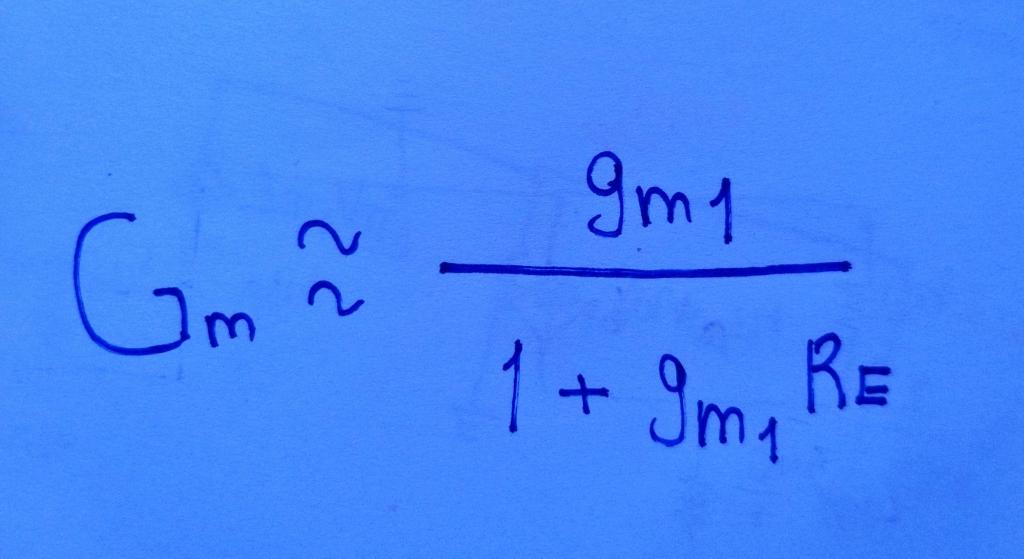
Finding the Short-Circuit Transconductance of the Cascode Amplifier without the Emitter Degenaration


output grounded, and the current flowing in from the output ground is measured
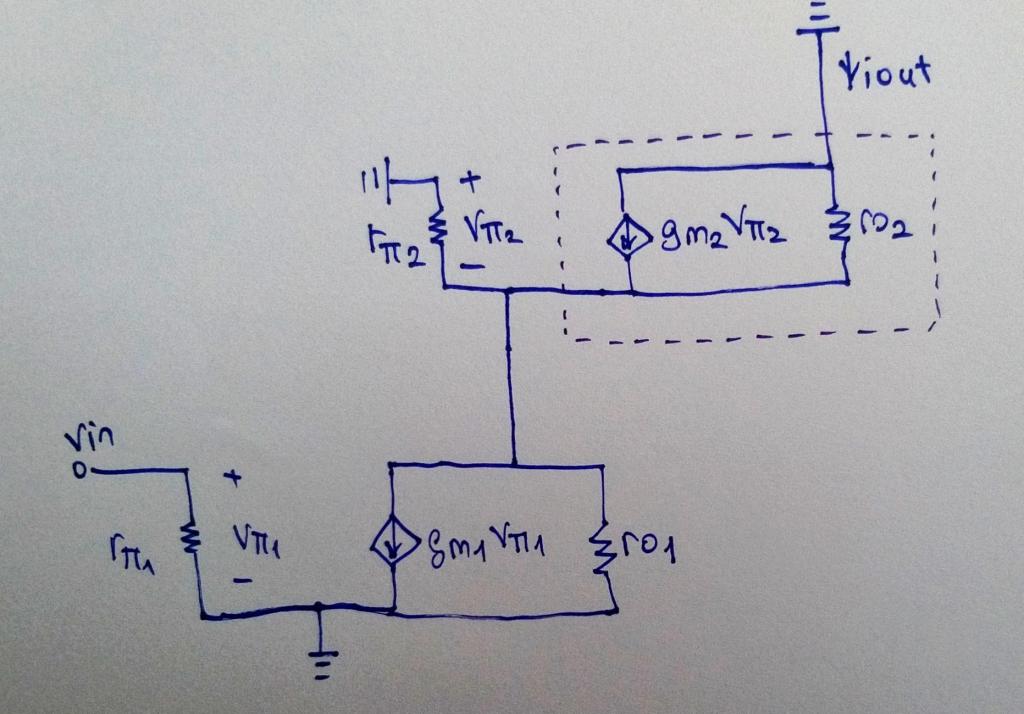
Since iout is equal to the current flowing out from the voltage controlled current source gm2Vpi2 and ro2
we should find the equivalent resistance of that block
.
.

We find the resistance of that block as Rout. This is the resistance of a diode connected stage.

Then we can assume iout to be flowing in through this resistance and into the rest of the network.
The small signal model of the circuit now looks like the figure.
.
.
With the block resistor pulled down and the above rpi2 paralleled with ro1, we can present a cleaner circuit as in the figure.

As can be seen clearer on this figure, iout, flowing in through 1/gm2 || ro2 gets divided between ro1 || rpi2 and gm1Vp1. To get a bigger Gm, the fraction of iout getting divided to flow into ro1||rp2 should be as small as possible, because without this divison, knowing that Vin=Vpi, Gm would directly equal gm1. Anything flowing in to ro1||rpi2, since that term won’t be related with Vin directly, will just subtract from iout (thus anything that flows there reduces Gm).
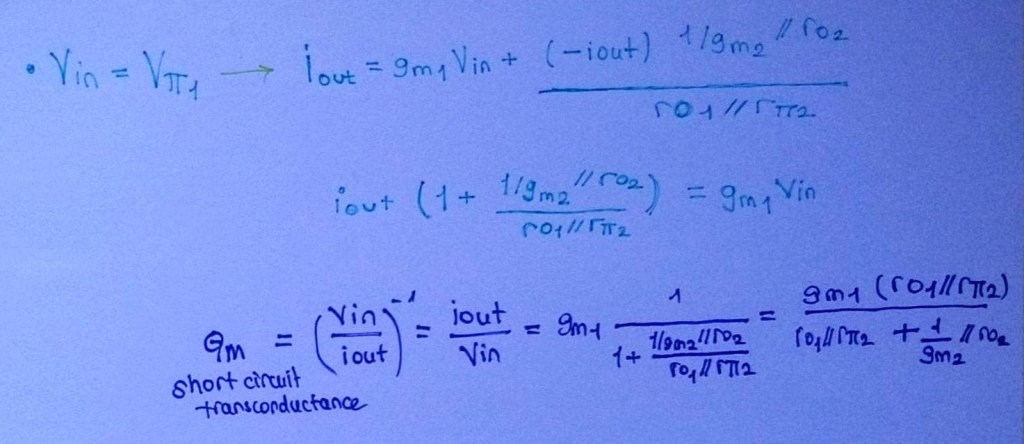
Continuing with the analysis, the current flowing through ro1||rpi2 can be found by dividing the voltage across it by the resistance.
The voltage across ro1||rpi2 is the same as that across 1/gm2||ro2. Current flowing across 1/gm2||ro2 is iout, but its direction means the voltage at the above node is negative. Multiply this current with the resistance to find (-iout)*(1/gm2 || ro2)
Collect the terms under Vin and iout parantheses and find Gm
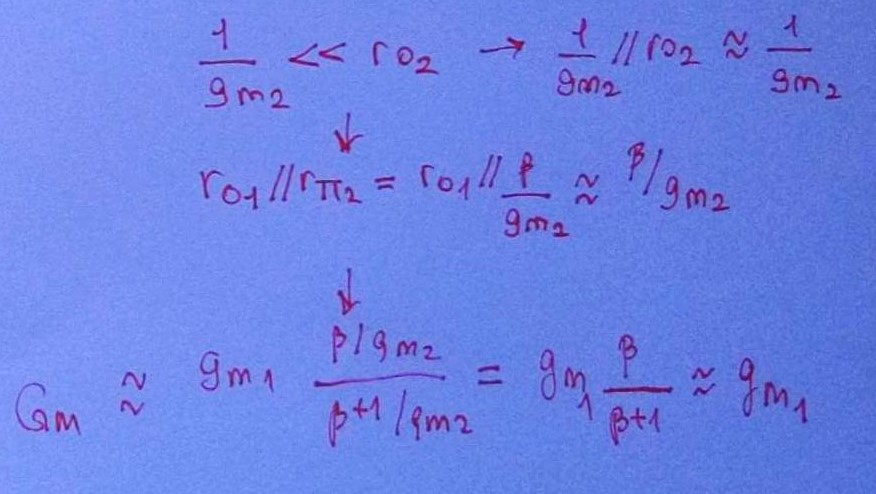
Then making these approximations we can find Gm to be gm1
 Giray's Sandal
One thought on “Short-Circuit Transconductance with Emitter Degeneration”