First of all, I posted a shorter version of this post before on my Blogger blog but then decided not to use Blogger anymore so I will be posting it here as well. It is an important post for me, since it is the first time I ever wrote about climbing. Originally I wrote it as a YouTube comment on their video and it got a like from the DabRats account, so that made me really happy 🙂 I hope content creators like them know what they’re doing is being appreciated and is being taken seriously.
The video is made by @xiangoh_ and its a climbing workout video in which she also shares some self-learned climbing lessons. I found it really entertaining because her advice helped me put all the training I did in the past few months, since starting climbing around late february, into retrospect. By questioning and reviewing my own experience, I was able to arrive at fresh, new ideas, which will help me establish a balanced and grounded outlook on climbing.
- Everyone is different – Take charge of your own training – Advice is suggestion
- Strength & Technique are not opposites – Strength Training is about Respecting your Body
- Hold Yourself to Your Own Standards – Rock Does not Discriminate
I tried to collect the three lessons in one list. I want to elaborate on each to show why they could become the basis for a grounded and balanced outlook on climbing.
For the first lesson, Xian mentions how she was told not to work legs because she would not be dependent on them, but how her legs were her weak point and that working legs really helped her climb.
Progress means something else for every individual. Because I’m just starting out with climbing, anything I do helps me progress. However, the first few months of climbing were really chaotic. I didn’t know how to train and what to train. I was constantly bombarded with advice from my climbing buddies. I watched them progress and I tried to match their training. I was trying to do whatever they were doing, and they were almost always trying to climb overhangs and dynamic moves. I guess I wasn’t really ready to try overhangs (by overhang I refer to any route thats not vertical). I didn’t know how to control my hips and I had no idea how to get closer to the wall. I never topped anything that had an incline during the time I spent training with them.
I guess all of these lessons boil down to a single message: Progress means something else for every individual. After starting to train on my own, I developed my own pace. Three times a week I was going to the gym, and instead of being suffocated by all of these different types of training, I was just doing what felt good for me. This is what’s advised in the first lesson. I did my own training, trying to work on strength and core at least once a week, and continued training front splits and stretching. Front splits had no place in a beginners training regiment specifically modified for climbing, but it made me really happy. I felt like it moved me towards my own goals.
I started watching competition climbs and I was really happy when I saw people like Alex Megos and Ashima Shiraishi doing splits and “breaking the beta”. Seriously though, just how flexible is Alex Megos?

By following a training regiment that made ME FEEL GOOD, I started getting strong almost immediately. I started climbing inclined surfaces soon after that.
The main point is keeping up the motivation. When you go at your own pace, its almost impossible to stop climbing. Each session you see yourself improve and you become better.
When you are only beginning to work on something new, its a huge deal not to get demotivated by the weird standards suddenly appearing infront of you. Your own pace helps you fend off those standards.
Then we come to the third point, the rock does not discriminate. Even though I may go at my own pace, the rock will demand of me something that may not come so naturally to me. For me, this is basic finger strength (or strength in general) and core. Throughout my brief climbing career of almost 4 months (and a one month coronavirus lockdown break in between) I’ve gained so many climbing friends. The one who I climb with the most right now is someone who climbs routes graded way harder than mine. Even though he climbs much higher grades than I can, he never judges me. He never invites me to try “out this sick dyno” that he nailed first try because he’s so good — im pointing a finger at you my dear old friends 🙂
My new climbing buddy is really good at strength related stuff, he used to do a lot of strength training. He is also able to perform at a very high athletic level. Its so fun when I ask him to do core workouts together, they are the hardest I ever do!
The rock demands of him, and me, the same things. If I wanna stand on top of a route, I have to be as able as he is. This does not necessarily mean I have to be as strong as he is. Maybe I won’t be able to lift as much as he can, but I need strength to get me up there.
I go at my own pace while always having an eye on whatever the other people are doing. Are they training finger strength? That seems to be the key to grades color-coded grey or higher in my gym.
Should I be frantically focusing on my finger strength right now? Probably not. I’ve got a long road ahead of me. There are so many routes I will be able to manage if I just improve my technique.
I won’t let my lack of finger strength demotivate me. It’s not the end of the world right now. But I probably should start working for it, step by step. Starting small.
I think this is what is meant by lesson 2 — Strength Training is Respecting your Own Body. In Xian’s words, “climbing is a really demanding activity. If we want to try something that’s difficult for us, push ourselves, its really important to give our body what it needs.” It may be looked down upon but the time spent in the gym is so essential to climbing harder.
Time spent in the gym does not have to be time spent lifting weights. It means the time spent studying climbing and discovering the training needed to excel at it. Campusing is a good example of something that requires strength. It not only requires it but also builds it. It gets you stronger for the climbs ahead that require generating explosive upward momentum.
This week I tried practising the campus board with hemisphere holds. I tried it out with a big smile on my face which didn’t disappear even after I fell from the second hold. In my past training history (years ago now) I spent months doing pull-ups and I used to get compliments for the accuracy of my pull-up posture. However, I seem to be lacking the strength to go above the second hold. In my first try I wasn’t even able to hold the second hold. In a session a few days afterwards I could hold onto it for a few seconds. Maybe that was because I was using the smaller hemisphere, and that made the grip a little easier, but a very welcome progress nonetheless 🙂
I didn’t lose the smile on my face because I held my self to my own standards. I was with my buddy and I knew I wouldn’t get judged. The rock will require this strength of me eventually, regardless of whether I am man or woman, and I have no shame in putting down the baby steps towards that goal.
To sum up, I want to use some quotes from the climbing documentary, Rotpunkt.
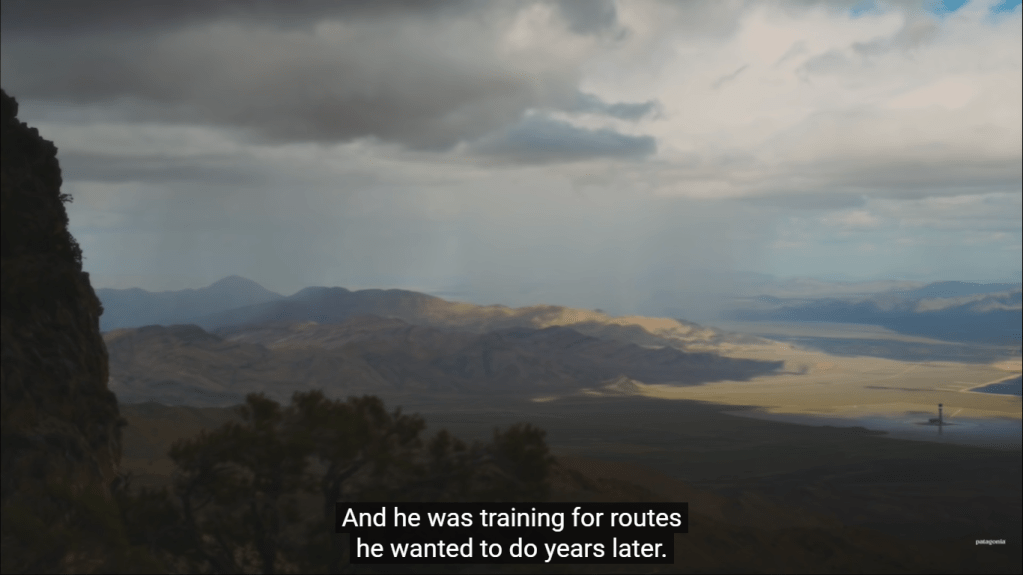
This is a screenshot I took of the documentary. They say Alexander Megos was training for routes he wanted to do years later.
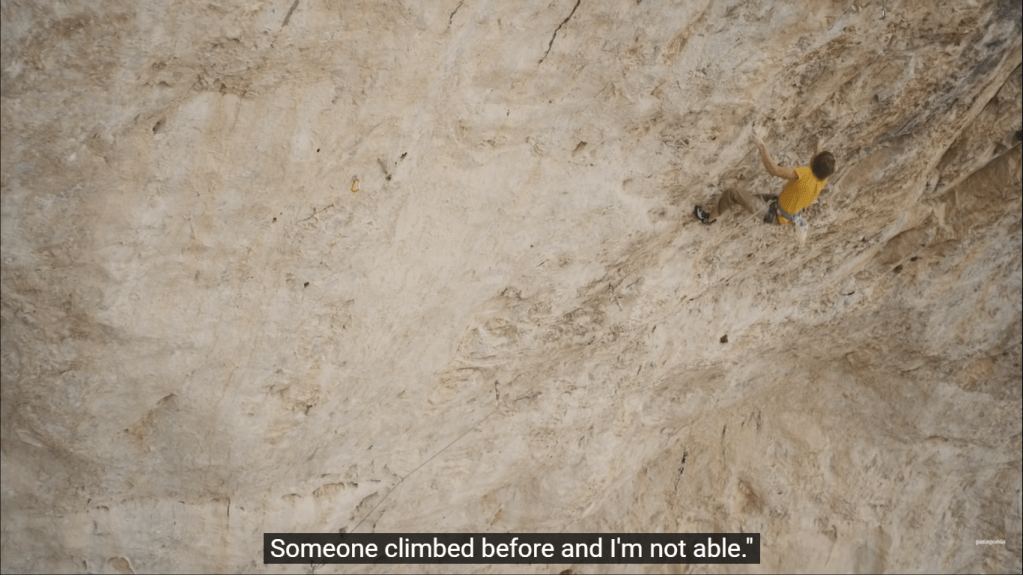
His coach talking about him
When there is chalk on a hold, and someone held it before,
and you’re not able to hold it,
to accept this? I’m not the best?
Someone climbed before, and I’m not able
It seems that this feeling of being there competitively, and being too hard on oneself, is something that exists for everybody climbing at any grade. Alexander Megos is someone who has to compete with climbers on a very high level (Adam Ondra as competition? That must be hard on your psyche…) However, as we see in the documentary, Alex Megos is competing only against himself. He only competes against chalks on holds, left there previously by an incognito climber, a whisper in the wind.
This mentality exists for all of us. We compete against ourselves. The competition scene is full of amazing climbers who individually excel at something unique. Watching bouldering competitions I see Janja Garnbret sticking a huge dynamic move with unparalleled strength; in lead competitions, I see Adam Ondra flowing through a route with graceful accuracy. I am filled with an overflowing desire to celebrate the uniqueness of each of these athletes.
In my own training, I will do what I feel is right for me. In retrospect, I see how scheduled training enabled me to slowly start climbing strength-heavy routes . When I look into the past, I see myself with a huge shouting laugh on my face, after I jump down from the top hold of an inclined climb. I feel the satisfaction I get after I train with weights. I feel the serenity that comes after going down into the splits.
As I continue my own training, I will always be on the lookout for improvement. I will try to see what my friends are doing, and I will attempt to do them to see what I am weak at. I will start working towards my own goals, because the rock does not discriminate. Holding myself to my own standards, I will do what I need to do to get up there.
…..
I feel like these ideas could become the seeds for a base, which will later on develop into a very integrated and powerful style of climbing and climbing training :))
 Giray's Sandal