
Humans tell stories
Humans tell stories of their ancestors and of ages long gone. Stories of the ancient past are so powerful, that nationalism used them to craft nation identities, with which they could bring the people together and lead them. Ancient Danish Kings claimed divine ancestry through stories, reinforcing their positions as rulers by connecting themselves to the Norse Gods (see: The Song of Rig). Yet ancestor stories are not only for those who seek political power: we’ve been telling stories of our ancestors, since the first humans spoke. Maybe even before that, maybe even before language… Telling stories of our ancestors is one of our most pure hearted, most primal efforts. It is like putting paint on a cave wall, creating the first symbols, the advent of human symbolism; it is like having faith for the first time, the first human to ever feel the existence of something greater than themselves, something that transcended their short lifetime–time,eternity,beginnings and endings, the universe–and they stood in awe, witnessing it.
And we created… We created the paintings and the faith. We created the tools to hunt animals far bigger than us. We made clothes out of their skin to adorn and protect our bodies. Our creations were so important to us; that we had to hand them down to our children. We had to let them know what we learned, what the ones before them accomplished. And all of our teaching rode on the backs of stories…
What Suns did our ancestors hail? What majestic beasts did they encounter? What journeys did they embark upon? Through our stories we pass down to our descendents who their ancestors were…
stories are powerful
The stories we crafted were so powerful, that they granted the inheritors power—the power to create the future.
How? Because they gave them purpose.
Through our stories, we inherited the souls of the humans who lived before us.
We tell stories to teach, to warn; to mourn and to praise; to pass down whatever touched our souls. Don’t we? One of our biggest story collections, the books of the great Abrahamic religions, are full of stories about calamities, about exoduses. Also, there are human stories in them too: stories of betrayal, of love, of companionship; there are stories of great success, feats of planning that made civilizations rise.
When we read them, we find purpose in life. When he hear those stories, we are driven to look at the world with new eyes.
I know that every paragraph of a holy book I read, makes me question a different facet of life; and through that questioning, I am led to making new decisions.
How can they have that kind of power? Because they are the culmination of the work of many past people, who dedicated their lives to thinking about those questions, about those facets of life. Through deep contemplation, through themselves inheriting the traditions and ways of life of their own ancestors, they set down the questions and the knowledge they crafted, and meticulously stocked them into stories, so they could pass them down to the next generation.
What we inherit, is their ways of life, their traditions, and their “Q&A”s about life. When we are born into a community, we are fed the collective work of countless generations of people from that community. The human species is dynamic.
We don’t exist alone. While we can so easily grasp that the bees have a hive mind, why would we be so blind to not see that we ourselves are part of dynamic groups of organisms, people flowing through time and space, on the planet Earth? People migrate, people form groups, they move and they settle and they get up and leave; and in each climate, each portion of land they face, they have to adapt new ways, the land itself changes them; transforms and sculpts them. We look the way our geography molds us to do.
our DNA tells the story of our tribe
Even our genetics have their own story… We look at someone, and we can guess where their ancestors came from.
And there needs to be no shame about doing this. There can be pride instead.
If we could replace only fear with curiosity; then instead of the violence that fear breeds, we could breed love out of curiosity.
I feel like so much of the book the Wild Seed is about this… And is so cruel, so brutally truthful, that it captures all sides of it. The fear, and the love. The disgusting violence that some brought upon others; and apart from that, existing right next to it but shielded from it: a rare, beautiful growth, which some could achieve through union.
Union creates new people. New tribes are born… New eyes to look at the world with…

“No feeling was better than that of being surrounded by her own. Her children and grandchildren and great-grandchildren. She could never have been content moving constantly as Doro moved. It was her way to settle and make a tribe around her and stay within that tribe for as long as she could.”
Page 210, Wild Seed, Octavia Butler
When we look at someone, their genes tell us a story. This is their treasure. They carry within their molecular story-books–their DNA–the record of the journey of their ancestors. What majestic lands were they born in? How was the climate there? Who were their neighbours? What did they do to survive? All the values and qualities their homeland cultivated. And where they are now. Who they have become. It all makes us who we are.
mother feeds her baby the stories of her ancestors
Humans are a dynamic species. We form tribes, we move around, and we have to tell stories. Each person born into a community, inherits all the stories of their community, from everyone around them. The mother feeds her child food and thought.
We pass down our language, uncontrollably! Our brain has somehow evolved a capacity for sound symbolism, so great, that the only thing a baby needs to do to learn a new language, is to keep listening… Beauty, the beauty of life… And what greater storyteller is there, other than language?
Language holds within it countless generations. Language captures within it the stories of innumerable ancestors.
MY GRANDMOTHER, Semra Arat, a teacher of geography from the northern coast of Turkey, once quoted something she remembered from her Grandmother, who was born in the 19th century. A past that’s so far back, that I have a hard time even imagining what it must have looked like. Yet, it is so close.
She said:
My grandmother used to call someone “Genoese-minded” if they were smart… Who were the Genoese? What did they do? So that my grandmother was calling people genoese-minded?
what my grandmother semra arat said about her own grandmother şerife
My ancient, quoting her ancient, who is quoting an idiom from an ancient past…
Short detour: who really were the Genoese?

The Genoese were a seafaring people from Genoa, a mid-medieval republic from lands that are now called Italy, who established colonies very far-reaching for their time. If you read about the origins of the Crimean Khanate, you will hear them mentioned frequently. They somehow established colonies in Crimea, in the year 1266! That’s unbelievable for me. Because of the modern political situation of the region, it is unthinkable that a seafaring community from Italy could pass through the Meditteranean, cross over to the black sea, and establish trade and commerce ports in Crimea.
They shortly lost these far-reaching outposts, when the Ottoman Empire conquered their Crimea branch in the year 1475. The Black Sea colonies lasted only 200 years.
My grandmother’s Grandmother Şerife lived in the early 1900s, not in Crimea but in Sinop. How could the name of the Genoese still exist in her language, without her ever hearing any mention of them or seeing any relic left from them, that kingdom which existed more than 400 years before she was born?
This is the beauty of language –> This is the beauty of stories –> This is the power of stories –> This is ancestral recall.
The Cave of Ancestors

The cave you see at the beginning of this article is called “The Cave of Beasts”, and it’s in the Western Desert in the Sahara, in Egypt.
Another cave exists nearby, called “The Cave of Swimmers”.
Both of these caves have wall paintings dating back to prehistoric times, i.e. the paintings are so old, they’re older than our oldest written records. (Wikipedia: older than the advent of writing systems)
The Cave of Swimmers was discovered in 1933. The paintings on the walls show people swimming… But how can people be swimming, when the cave is in the middle of a desert?
THE PALEOLITHIC LAKE OF NORTH DARFUR
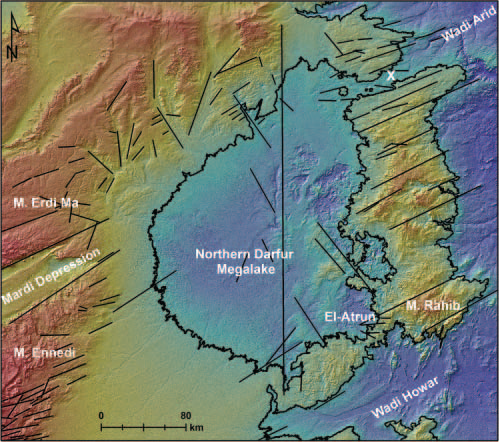
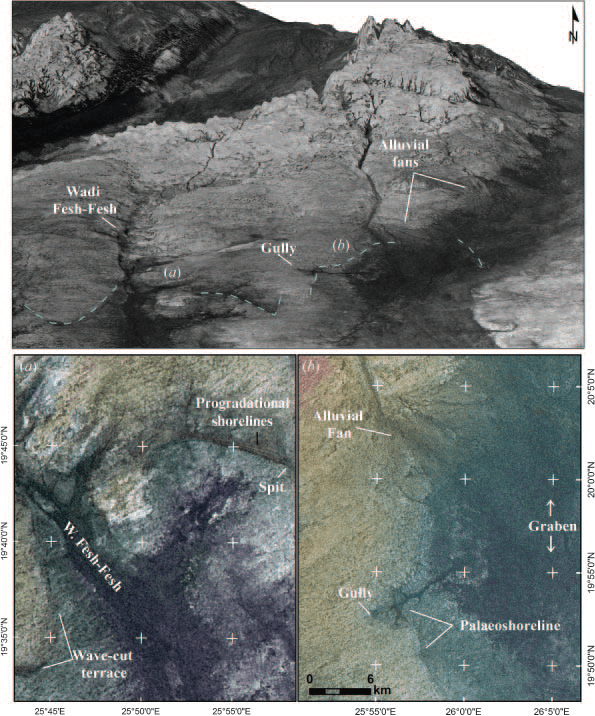
Yes… in ancient times… there was a lake there…
oh the ancestors. They drew on the walls so we could know…

the northern Darfur, Sudan: implication for groundwater exploration”
E. GHONEIM* and F. EL-BAZ
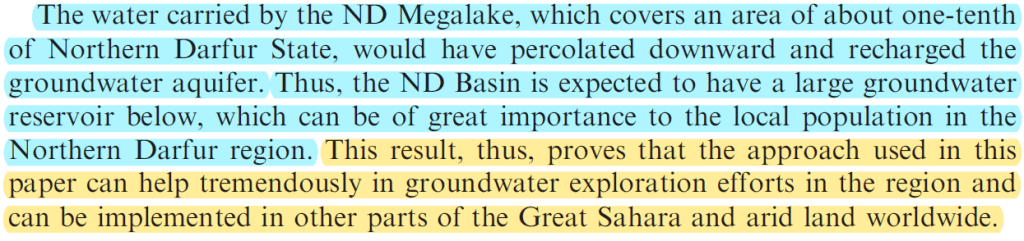
Eman Ghoneim, an Egyptian scientist woman, working together with Farouk El-Baz, who was an Egyptian scientist who built space missions for NASA, discovered its existence in 2006.
She has so many articles, none of them referenced on her Wiki page. Why doesn’t anybody go on there and write about this?
There were lakes. We used to be swimmers. We swam around in the mega-lakes of the SAHARA.

the northern Darfur, Sudan: implication for groundwater exploration”
E. GHONEIM* and F. EL-BAZ
Ancestral… I’ve never ever seen a technical scientific article use the word ancestral.
This is the story of us. By looking at our ancestors, by hearing their words, we can now face the future.
I never thought science would use ancestor knowledge too. And yet, here it is, happening right before my very eyes.
We built satellites, and shot them out to space. We looked through them; at the World. We looked at our own, at our old lands. Ghoneim looked at the deserts, lying south of her homeland. She saw lakes, ancient lakes. We used to be swimmers. There were ancient, mega-lakes in the deserts of her homeland, of our homeland. And knowing that, she decided to face the future. What her ancestors told her, what they painted on the walls of the Cave of Swimmers, will help her find water in the future. With the divining rod of data processing, they can look for water; understand the effects of the climate on the desert; how water moves beneath its rocks, how its sand recedes and advances with the tides of time…
the northern Darfur, Sudan: implication for groundwater exploration”
E. GHONEIM* and F. EL-BAZ
we look at the ancestors, and see our future
ancestral recall
 Giray's Sandal
3 thoughts on “Ancestral Recall”