


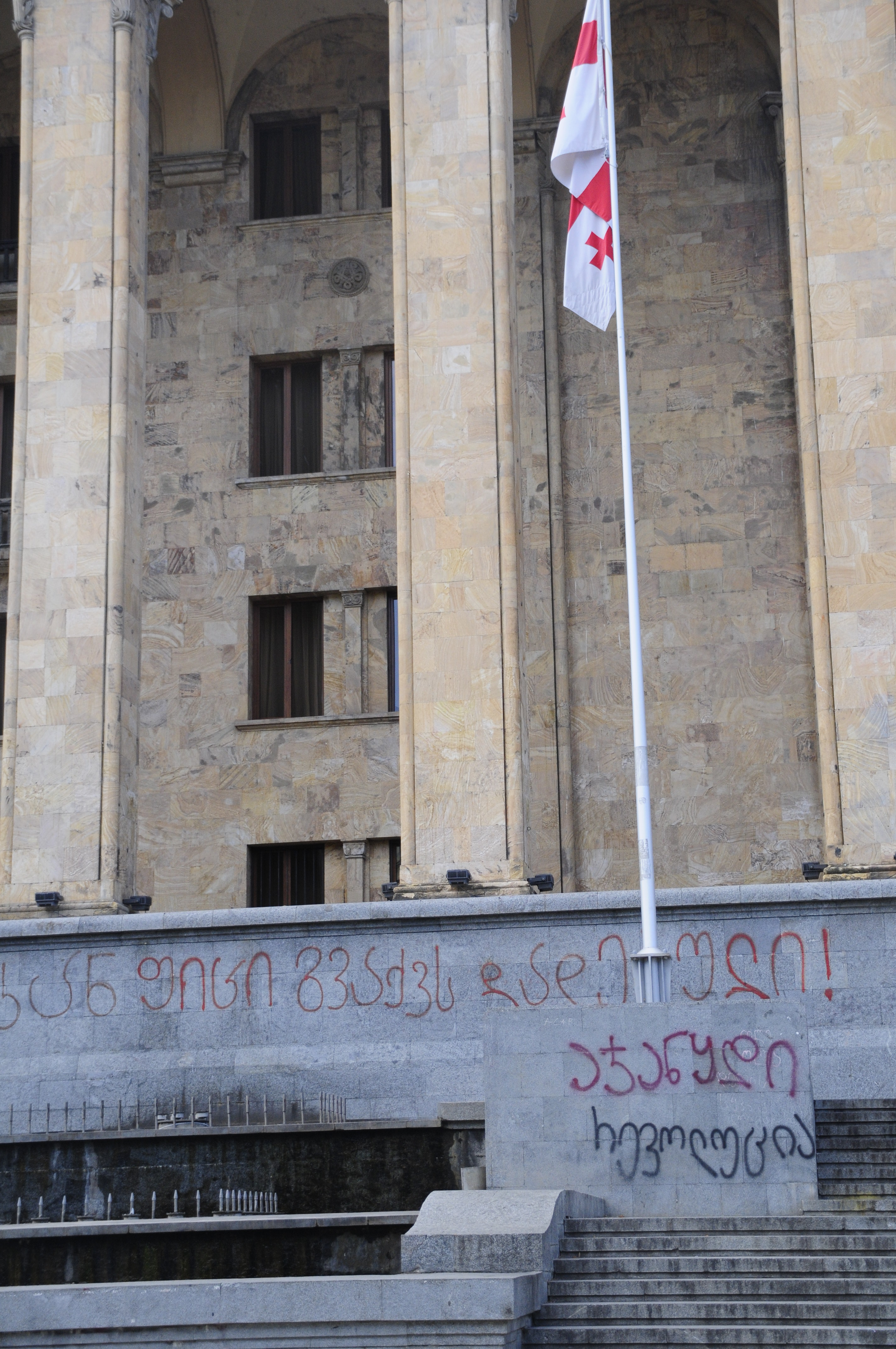

The Gruzian Parliament looks a lot different these days, compared to what it looked like a year ago.
People walk past it; it’s current state perfectly woven into daily life.
A very important S.M.H. (Significant Moment in History).
thoughts not related, but maybe are:
Coming back to Istanbul after Tbilisi is feeling a sense of blown-out-of-proportionness, that we as Turks and Istanbul have outgrown natural scales unlike Tbilisi, who seemed like it could support an organic character, a finite volume, which might make a Tblisian feel like there was something to work with in life; like a limited but playable game instead of our Constantinapolean infinite-game, a state of feeling insignificant and totally powerless and alien. Tbilisi feels like it could be a national home, a capital, constituting a certain amount of people, delimiting a family — we on the other hand feel like we can’t fit into any street, any bus, any central square –there’s simply too many of us –an undesired conglomeration>>
And I’m guessing the feeling of being too many is not even about scale,, (we’re not in Delhi after all)>> when i imagine us ditching Istanbul for a small town, in hopes of establishing different ideologies of community there, it still feels like we would be outnumbered. Whenever something of substance could be achieved, this big fog looming over us would descend and crush us, or those of the townfolk feeling out of accord with us would use their extended power stemming from the overall national (if we still refer to a nation) blown-out-of-proportionness to stomp us out themselves, feeling like it was their right, or that there was no repercussion.
In this country you (i) simply (we) feel like there are forces bigger than my organic comprehension, which will always be there to blow me out of the proportion (a proportion i can’t be a part of, this mass (of neverending people)…)
A short time after writing this i found myself thinking of languages I could learn that are in some socio-political (and linguistic) way related to Turkish. I am learning Greek now, so i thought maybe Georgian, would it have connections that nobody knows of? If learning Georgian, maybe I could try another Caucasian language that’s more closely connected, like Armenian? But if i did that, maybe it would make “more” sense to learn a “minority language” that’s “more” relevant to political debates today, which would be Kurdish? If I went that far though, I might as well learn a bit of Farsi since they’re alike, and if I’m learning Farsi I must learn Arabic. Then I would be completing the traditional trio of the Turkic Islamic Nation: Arabic/Farsi/Turkish! But then I’d also want to learn my personal interest Kazakh, as a Turkic language that’s closer to the “national root language” of Central Asia! And if I had learned all these languages, I imagine I would be invited to a TV show, like do all the other great social intellectuals like Ilber Ortayli, and then there I would declare myself, rightfully, as “the physical approximation of the intangible fabric of the Turkish nation!”
This ironic dream, this funny chain of thoughts. Though it seems impossible, I guess there have been many who have attempted some form of it. Learning Farsi and Arabic to understand Turkish better reminded me of the Nisanyan Etymological Dictionary, that great (and only) online source of Turkish etymology whose author, as far as i understand, created it, (out of spite,) to bear witness to the undisputable truth of the variety of root languages that has provided words to Turkish.
Making a horrible choice of an intellectual to quote here, but, this reminded me of one of Nisanyan’s youtube vids where he addressed a hypothetical young intellectual angry at Turkey. He said that he would, “I’d advise a young person with anger in their hearts to turn their hate into work.” … (and create a dictionary like he did, i guess.)
Maybe my sudden subconscious jump from this feeling of being lost and insignificant in Turkish society, to “becoming the physical approximation of its Underlying/Constituent/Founding tapestry” was a similar drive to his sentiment, albeit a much more at peace one: a drive to do work in response to an opposition which i felt powerless to battle.
Feeling lost as a modern Turk, out of place in its standard modern identity, i’d become all the elements that have ever constituted it: from escape out of Ergenekon, the Glorious Turkic roots, to the Persianification that happened in Khorasan, the Seljuk days, the first adoption of Islam… and all the way to consuming BYZANTION, to putting that first minaret next to a dome…
I would pick up every single linguistic and cultural stone on that milennia spanning pathway
 Giray's Sandal