At work i’m writing about emergency mobile communications systems around the world because the company is building some. I’ve been reading about all kinds of disasters from all around the world: Turkiye-Syria earthquakes, Hurricane Katrina, Cyclone Fani in India..
When looking up devastating earthquakes, one that was listed to be the highest on Richter scale was the 1964 Alaskan Earthquake.
I first ignored it because the casualties were lower in comparison to others. It was the highest on scale but lower on devastation. Turkiye had numerous quakes where 30,000+ ppl died while Alaskan quake killed 300 ppl. It’s probably because of the lower population density of Alaska and that there were less tall buildings.
Nevertheless, when i finally took a look at the Wikipedia page for the earthquake, i saw the immense destruction. Turns out it actually was one of the largest magnitude earthquakes on record. It was so devastating, that the streets were warped. Check this photo out:

In any case, even though the casualties were lower, probably the whole infrastructure in the city collapsed. An earthquake of this size must have destroyed all kinds of plumbing, electricity lines, comm lines etc.
Just like any major earthquake, I’m guessing there was a big problem in the aftermath: tons of people living in a completely dysfunctional city, but they have nowhere to go. In the Turkish quakes, there were tons of tent-cities built up by the government and other agencies to support quake-victims.
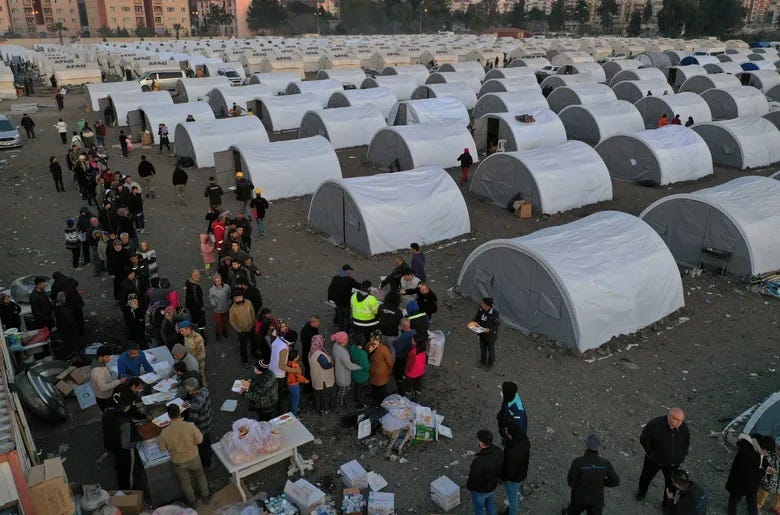
I even experiencied living in one of these tents for a while. I attended an NGO’s efforts to help people in the area. I did an interview with another helper there, and you can see the tents behind us in this video/article:
Genie Chance and the role of Journalism
Today i learned about Genie Chance from VisakanV, a journalist who covered the Alaskan earthquake and then worked as a public communicator for the earthquake-struck municipal government. From the Wikipedia page:

“Coordinating response efforts, connecting available resources to needs around the community, disseminating information about shelters…”
These are the exact use cases of the mobile communications techology that my company is building!
I can describe reporting as the act of delivering information to the people who can benefit from it, and through her reporting, Genie Chance became the most optimal candidate for becoming the voice of the government in coordinating disaster management efforts. Through her ‘reporting’ she ACTUALLY contributed to saving lives!
This is an example of how writing can have actual, credible, tangible impact on societies and can be a flesh and blood improvement for society.
Writing as tangible Impact
I saw a tweet recently about someone who’s opinions changed after reading an ‘opinion piece’ about solar panels. They said they always thought of writing as an archival effort, but now realize for the first time ever how writing can actually “move the needle of humanity’s progress”.
Writing in all its forms; journalism, science fiction, historical novels, etc., create real thoughts in real people’s heads… and those real thoughts turn into real actions… Creating real impact.
There are heightened periods when ‘opinion pieces’ get converted into action at a higher rate than normal. Aftermaths of natural disasters like earthquakes are one. When a journalist broadcasts guidelines for survival or location of aid centers, that directly causes listeners to move. Based on information they’ve learned, they do something they wouldn’t have done otherwise.
So then, when we are faced with a major societal problem, there is an ecosystem involving so many actors and physical factors: you have the physical material (the vaccines, vaccination centers; food supplies, aid centers), and you have the means of communicating information about them (independent newspapers, radio channels) and you have the people responsible for organizing information and delivering it (journalists, writers).
Communication of this kind is a challenge of its own and needs a special kind of expert to take care of.
A journalist is an expert that can help solve this problem because they know how to navigate information. They know the ins and outs of communication, so they can untangle the messages and turn them into forms that can help the most. Skill of this kind is in demand, especially in times of disaster. That’s how Genie Chance could step up as ‘the official public information officer’ for the Alaskan government.
 Giray's Sandal