Detangling Symbol and Object
Saussure’s Course in General Linguistics, the work that gave rise to semiology,tries to expose the universally held fallacy of “assuming that ready-made ideas exist before words”. By putting forward the concept of “differentiality”, Saussure untangles sign from object, disconnects symbol and reality. This has tremendous impact on all philosophy to come. We start to look at things we thought held intrinsic meaning and find that we have attributed those meanings ourselves, or that they have no meaning other than which they have in relation to other meanings. Our previous conceptions of common-sense and nature turn out to be arbitrary symbols given form by the arbitrary systems of differentiality that surround them.
One thing I’m curious about but can’t be sure of just by looking at the text is if Saussure took this “structuralism” to its extreme limit like his philosophical successors did. Eagleton, in a section titled “Structuralism and Semiotics” says of the end result of this way of thinking: “It was impossible any longer to see reality simply as something ‘out there’.” If this definition is true, there should be, according to structuralists and semioticists, no concept of “mother” and “father” on their own. These must be social constructs that exist only due to their differentiation in language, which is how we learn of them, and not through our “natural experiences” as babies. (And I’d fully agree with the arbitrariness of this particular example, because I’ve heard of early human societies being fatherless, that there was a mother but no clear knowledge linking that mother’s child to a specific male, as there was no monogamy, and genetics was not invented yet.)

If this is so, then Saussure’s words on page 70 makes me doubt if he also believed in the arbitrariness —or at least the independent existence— of these concepts: “The idea of ‘father’ and the idea of ‘mother’; two signs, each having a signified and a signifier, are not different but only distinct.”
Another thing that I am not fully certain of is what exactly is meant by “the value of words”.
Saussure compares different languages and the words they have for the same signifieds. He says that even though these signifiers point to the same signified, they are not equal, because one language may have other words that point to approximately the same thing, or to something entirely opposite but related, basically supplying the first signifier with extra meaning through their relation, something which the other languages may lack. Saussure is saying that the word with extra meaning attributed to it through relation would have more “value” than others without it. Like German having two words for two separate concepts that French combines into one concept and one word. Does this make German more valuable than French? Is Saussure talking about a hierarchical ranking of languages and words?
After our discussions in class, I have arrived at a new understanding of the concept of value. Course in General Linguistics is from the “scientific era”, and this might be why it’s using a concept from mathematics without defining it first. The word must be the analogue of an arbitrary variable, usually denoted by x. This arbitrary variable would then have a value, like x=5. Then value would be the meaning held by the word. Then it makes sense for Saussure to say, “The value of just any term is accordingly determined by its environment; it is impossible to fix even the value of the word signifying ‘sun’ without first considering its surroundings.”
I would like to add, keeping up with Eagleton’s criticism, Saussure must have ignored the impact of cultural reality impinging on linguistic meaning, just as he ignored “parole” in his formation of “langue”. In our classes, we discussed the words “bread” and “ekmek” in English and Turkish respectively. We realized that when we say bread, we think of a puffy, white rectangular loaf, but when we say ekmek, we think of a “somun” bread, elliptical and crunchy. Even without any lexical signifiers, we have a difference in the meaning of signifieds that should, in theory, be pointing to the same signifier.
To Really See the Signified
If Saussure’s work showed us that our words are arbitrary symbols defined by their relativites, then Shklovsky’s ostranenie (enstrangement) establishes the process by which these relativistic symbols can carry out an artistic effect.
The disconnected symbol really does hold no meaning other than its difference to the other symbols, so encountering it for the ten thousandth time our brains become numb to it. We process its meaning without even conjuring up an image of what it signifies. In this case, words are nothing more than words, and there’s almost a total disconnect between symbol and reality. This is what daily language is like…
Imagine a beautiful red rose blooming in a garden of flowers. It is so red that it looks like fresh blood crystallized. It is so crimson that even in daylight, it gleams with shades of black.
A child sees this rose, and seeing this shade of red for the first time, is amazed.
A gardener sees this rose. They water it and leave to carry on the work of weeding the grounds, not looking at it twice.
A poet sees this rose, and enraptured by its beauty, composes a poem:
“I saw it then, a gentle green cord protruding from the ground; crowned with red curtains delicate, and a crimson gown; so deep as to make jealous, even the sun going down.”
What is the poet talking about in this poem? A rose. This is not immediately apparent, we have to go through the words and conjure up those images and put together an image. The two word word-cluster, “red rose”, would be enough to describe it, but would that be enough to make us see it? By choosing words that do not directly describe the signified in question, the poet would push us to discovering its beauty, its real meaning as if it were our first time seeing it.
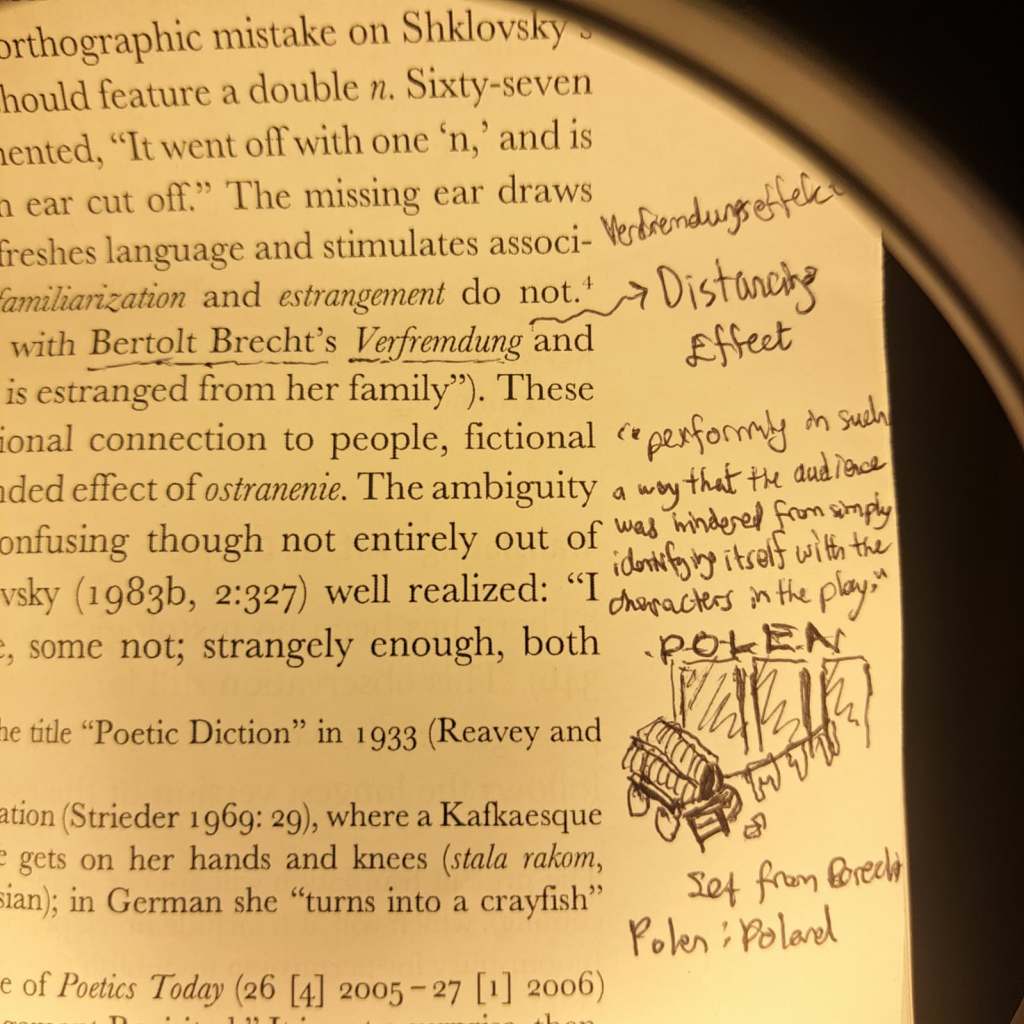
This is what is meant by enstrangement: By making recognition hard, the poetic language severs the all-too-familiar link between signifier and signified, makes us break the habitual and re-discover both symbol and our perception of the object that that symbol signifies.
 Giray's Sandal